
Mastering the Circular Business Innovation Process: your guide to Rapid, Impactful Change
- Feb 4
- 5 min read
Innovation is no longer a luxury - it's a necessity. To ensure future-readiness. To grow your sourcing autonomy. To keep up with changing customer behaviour. Going Circular pays off. But how do you turn ideas into action in this new and unchartered territory? That's where the circular business innovation process comes in. This proven, fast methodology helps teams move quickly, test boldly, and create solutions that stick. I'm excited to share how mastering this process can transform your business and set your organization on a path to impact.
What is the Circular Business Innovation Process? Why it Matters!
The Circular Business Innovation process is a focused, time-boxed approach to solving big challenges. Think of it as a fast-forward button for innovation. Instead of months of planning and debating, you compress the work into days or weeks. This means you can test ideas, gather feedback, and pivot quickly. Always related to your stakeholders' needs. So you can end discussions and boost progress.
Why does this matter? Because speed and agility are critical in today’s fast-changing markets. And opinions are often wrong. Our approach helps you:
Reduce risk by validating ideas early
Save resources by focusing on what works and is worthwhile
Engage teams with clear goals and rapid progress
Create momentum that drives ongoing innovation
Imagine developing and commercializing a new product or service in just a few weeks, not months. Or setting an exciting direction for impact, that staff and partners would love to collab on.
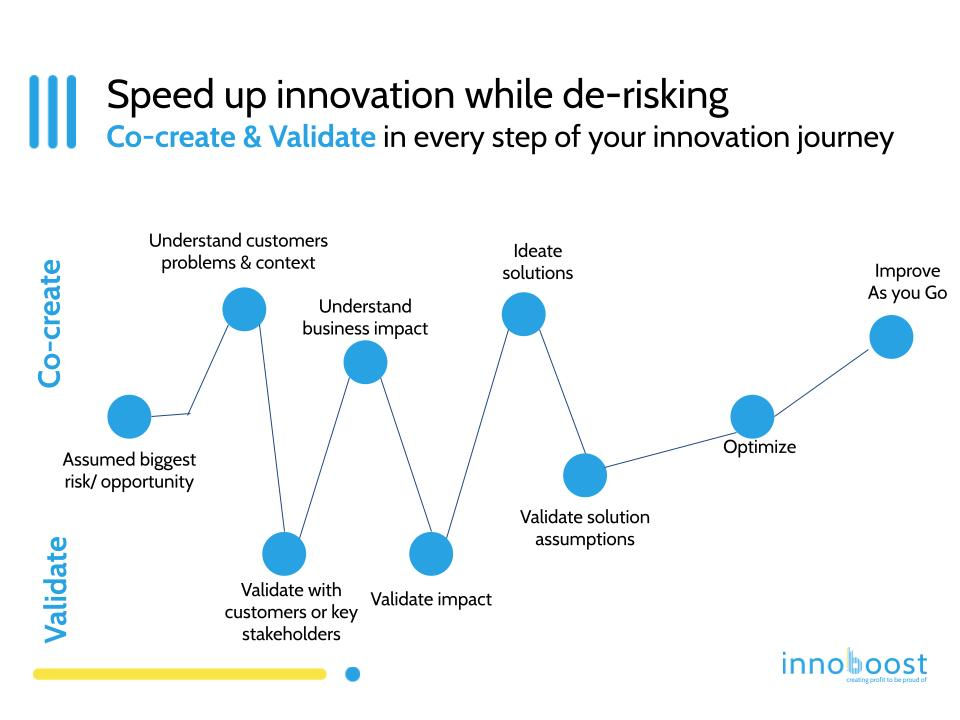
Step-by-Step approach
Let’s break down the innovation sprint process into clear, actionable steps. This framework is adaptable but usually follows these phases:
1. Define the Impact challenge
Start by pinpointing the exact problem or opportunity. Be specific. It may help to start by identifying the value you are missing or destroying. And flip this to define the impact you want to achieve? Listing the assumptions related to risks and constraints. We use the Risk-to-Opportunity Scan for this. And Ecosystem Mapping. To set the clarity for focused work.


2. Assemble the Right Team
Bring together diverse skills and perspectives. From within your organization and partners from your ecosystem. Include decision-makers, creatives, and technical experts. A small, cross-functional team works best to keep things nimble. Together with a steering committee to summarize your findings and create support. And do the numbers, even when you can only guestimate. Calculating the new business value alongside societal and environmental impacts will help you build the business case.
3. Co-create Rapidly
In different setups and by using design thinking, we generate a wide range of ideas. Or scenarios. Encouraging disruptive and wild thinking while also seeking incremental changes, our goal is quantity and variety. By updating the underlying assumptions, we can prioritize the most risky ones and design a small-scale business experiment to validate this risk.
4. Prototype Quickly
The best ideas are turned into tangible prototypes: a sketch, a draft, a video; something envisioning the outcome, including the benefits for the user, society and the planet. The prototype doesn’t have to be perfect: the key is to create something testable, convey the idea, and gather insights from key stakeholders.
5. Test and Learn
Get feedback from real users or stakeholders in a short timeframe. What works? What doesn't? Were your assumptions right? If so, continue to improve the idea. Or use this insight to refine or pivot your solution.
6. Decide and Plan Next Steps
Based on what you've learned, decide whether to move forward, iterate, or stop. Stopping early can prevent significant investments in innovation later. Based on your findings, you can update your commercialization or further development plan.
This process typically takes 3 to 5 days, but can be adjusted based on your needs and availability.
Tools and Techniques to supercharge your Circular Innovation
To get the most out of your innovation sprint, leverage our proven tools and techniques. Next to the already mentioned Risk-to-Opportunity Scan or Ecosystem Mapping, we also value:
Envision the Impact: By calculating the new societal, environmental, and business value from an early stage, you build a compelling business case and secure resource support. Design Thinking: Empathy mapping and user journey mapping help you understand your audience deeply.
Storyboarding: Visualize the future outcome and the 2nd, 3rd, and 4th user experiences to identify gaps and opportunities.
Rapid Validation Tools: Build a closed community, direct or via social media, to test your assumptions with real users. Let them use their own words to identify key benefits and messages.
Facilitation Methods: Timeboxing, dot voting, and silent brainstorming keep the team aligned and productive.
By combining these methods, you create a dynamic environment where creativity meets discipline.
Common Challenges and How to Overcome Them
Circular Business Innovation is powerful but not without hurdles. Here’s what I’ve seen teams struggle with and how to tackle these issues:
Lack of Clear Focus: Without a well-defined challenge grounded in facts and regulatory expectations, sprints lose momentum. Spend extra time upfront to clarify starting points, collect data and set impact goals.
Team Misalignment: Diverse teams can clash on priorities or business language. In our facilitation techniques, we explain why we do things and where they fit into processes to build consensus early. And we invite partners from a minimal viable ecosystem: the willing and essential partners to close a loop.
Fear of Failure: We encourage a culture where sharing, testing and failing fast is celebrated as learning. And as a great way to overcome opinions.
Insufficient User Feedback: Never skip this step. Real-world input is your best guide. And can be collected fast with digital and AI.
Overcomplicating Prototypes: Keep prototypes and visualization simple. Include communication experts to turn information into compelling, easy-to-understand concepts that aim to test your most risky assumptions.
Remember, the approach is about learning quickly, not delivering perfection.
Embedding Sustainable Innovation for Long-Term Success
Mastering the innovation process is just the beginning. The real magic happens when you embed this mindset into your organization's DNA. Sustainable innovation means continuously evolving your business models and offerings to meet changing needs while minimizing negative impact. Over the years, Innoboost has developed and trained more than 5,000 professionals to innovate sustainably. Scaling impact capabilities.
How can you do this? Call us, or use our practical tips:
Create Circular Innovation Champions: Identify and empower individuals who drive an impact innovation culture.
Integrate Circular Economy Principles: Design products and services that reduce waste, promote reuse and regenerate systems.
Make change attractive: Offer rewarding learning journeys that help people understand why impact creation is crucial and how easy it is to apply in their daily habits.
Leverage Partners: Collaborate with experts like Innoboost to accelerate your innovation journey.
Build Feedback Loops: Use data and user insights to continuously refine your approach. Like adding business model innovation to your value proposition design, and including sourcing specialists to identify new and nearby partners.
By combining rapid innovation sprints with a commitment to sustainability, you can future-proof your business and create lasting value.
Ready to Sprint toward your Next Big Idea?
Circular Innovation sprints are your secret weapon for turning bold ideas into real-world solutions fast. They help you cut through complexity, engage your team, and deliver impact that matters. Whether you’re launching a new product, improving a process, or exploring new business models, mastering this process will give you the edge.
So, what challenge will you tackle first? Grab your team, set a clear goal, and sprint toward innovation that drives growth and positive change. The future is waiting - and it's yours to create.
Start your innovation sprint journey today and watch your ideas take flight.
Comments